Example usage
To use spenv in a project:
import spenv
import numpy as np
import pandas as pd
import matplotlib.pyplot as plt

print(spenv.__version__)
0.1.1
The dataset used in this example is the nyse data from the astsa R package, scraped from the astsadata Python module.
path = "https://raw.githubusercontent.com/evorition/astsadata/main/astsadata/data/nyse.csv"
data = pd.read_csv(path)

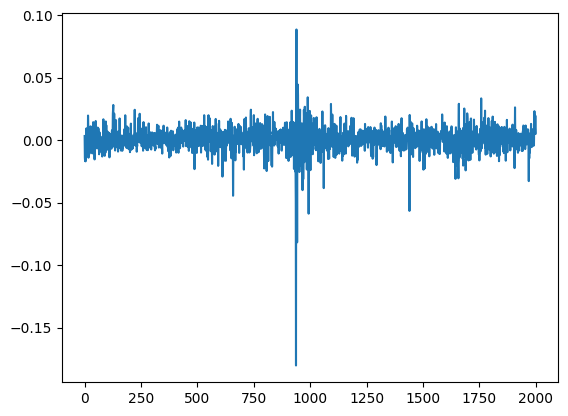
plt.plot(data.value)
plt.show()
Spectral Analysis
These functions can be used for spectral estimation of univariate or multivariate time series.
Tapered time series
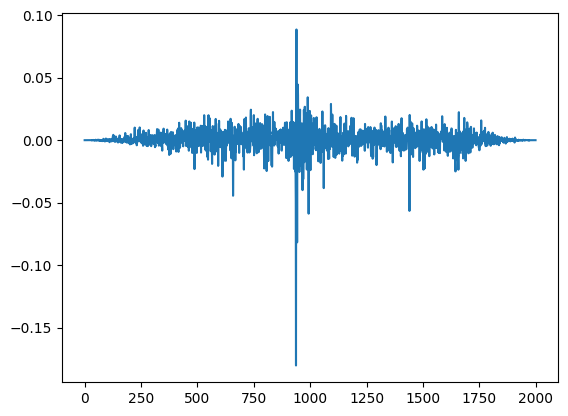
spec_taper applies taper smoothing to a time series.
plt.plot(spenv.spec_taper(data.value, p=0.25))
plt.show()
Multivariate Periodogram
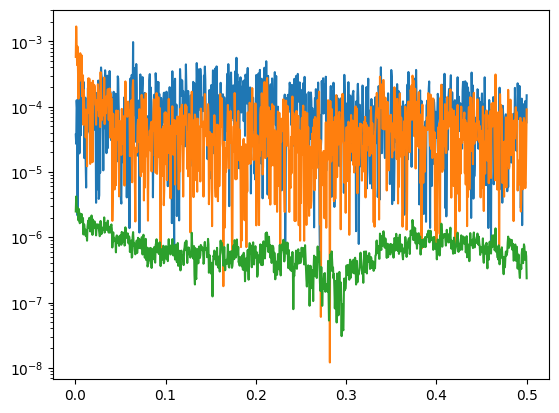
In this example, the (x, |x|, x2) set is used to generate a matrix for multivariate spectral estimation.
# reshape to a 2D array
vec = data['value'].values.reshape((-1,1))

# generate matrix
mat = np.concatenate([vec, np.abs(vec), vec**2], axis=1)

# estimate
pgram = spenv.mvspec(mat)
plt.plot(pgram['freq'], pgram['spec'][:,0])
plt.plot(pgram['freq'], pgram['spec'][:,1])
plt.plot(pgram['freq'], pgram['spec'][:,2])
plt.yscale('log')
plt.show()
Spectral Envelope
The specenv function computes the spectral envelope for the time series provided. The spec_opt automatically smoothes a time series based on the approach presented in Time Series Analysis and Its Applications with R Examples.
envelope = pd.DataFrame(spenv.specenv(mat), columns= ['freq', 'specenv', 'b1', 'b2', 'b3'])
envelope.head(10)
# the first and second variables show the frequencies and the envelope estimated
# the remaining columns show the coefficients
/home/docs/checkouts/readthedocs.org/user_builds/spenv/checkouts/latest/src/spenv.py:322: ComplexWarning: Casting complex values to real discards the imaginary part
  specenv[k] = ev[0]
/home/docs/checkouts/readthedocs.org/user_builds/spenv/checkouts/latest/src/spenv.py:324: ComplexWarning: Casting complex values to real discards the imaginary part
  beta[k, ] = b/np.sqrt(np.sum(b**2))
| freq | specenv | b1 | b2 | b3 | |
|---|---|---|---|---|---|
| 0 | 0.0005 | 0.011437 | -0.068884 | -0.633744 | 0.770470 |
| 1 | 0.0010 | 0.026382 | 0.004831 | -0.233153 | 0.972428 |
| 2 | 0.0015 | 0.016049 | -0.023791 | 0.270289 | -0.962485 |
| 3 | 0.0020 | 0.006597 | 0.043528 | -0.209931 | 0.976747 |
| 4 | 0.0025 | 0.015982 | -0.044775 | -0.391717 | 0.918996 |
| 5 | 0.0030 | 0.004889 | -0.081479 | 0.398915 | -0.913361 |
| 6 | 0.0035 | 0.003250 | -0.054930 | 0.156253 | 0.986189 |
| 7 | 0.0040 | 0.002765 | 0.278932 | 0.116058 | -0.953272 |
| 8 | 0.0045 | 0.000000 | -0.130564 | -0.091072 | 0.987248 |
| 9 | 0.0050 | 0.004344 | -0.096177 | -0.152392 | -0.983629 |
# plot the spectral envelope
plt.plot(envelope['freq'], envelope['specenv'])
plt.show()

# time series smoothing
smoothed = spenv.spec_opt(vec, np.abs, np.square)
# create a dataframe from the original and smoothed data
result = pd.DataFrame({'original': vec.flatten(), 'smoothed': smoothed})
/home/docs/checkouts/readthedocs.org/user_builds/spenv/checkouts/latest/src/spenv.py:322: ComplexWarning: Casting complex values to real discards the imaginary part
  specenv[k] = ev[0]
/home/docs/checkouts/readthedocs.org/user_builds/spenv/checkouts/latest/src/spenv.py:324: ComplexWarning: Casting complex values to real discards the imaginary part
  beta[k, ] = b/np.sqrt(np.sum(b**2))
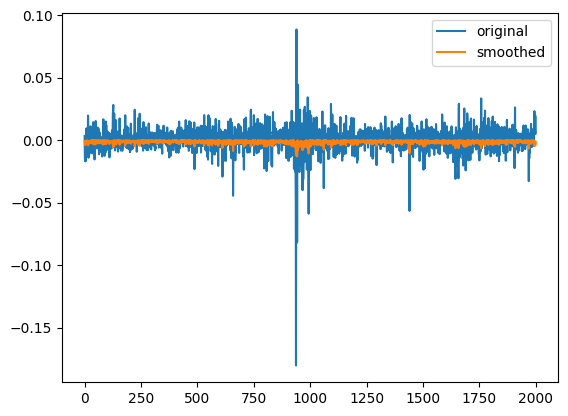
for col in result.columns:
    result[col].plot(legend=True)
plt.show
<function matplotlib.pyplot.show(close=None, block=None)>